
Monday, June 28, 2010

Sunday, June 27, 2010

Wednesday, June 23, 2010
OCONEE RIVER BOAT - PLEASURE CRAFT

Postcard of a group on a houseboat on Oconee River, Laurens County, Georgia, 1936
Description Laurens County, 1936. Group of people enjoy a ride down the Oconee River aboard Doctor Ovid Cheek's houseboat, Wieuca.
From: Laurens County Historical Society, Vanishing Georgia Collection.
1910 Buick, Cadwell, Georgia

Description Cadwell, ca. 1911. Men pose for a photograph in a 1910 Buick. Front seat, left to right: Homer Mullis, Bob Lee. Back seat: Hiram Mullis, Johnny Fann.
From: Laurens County Historical Society, Vanishing, Georgia Collection.
Monday, March 29, 2010

Sunday, January 31, 2010
THE DIXIE OVERLAND HIGHWAY
Historic U.S. Highway 80
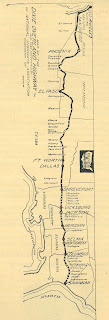
We call it the Old Macon Road or the Old Savannah Road, depending on which way you are traveling. It was once the way to Macon for Christmas shopping. It was once the way to Savannah, Tybee Island and fresh seafood dinners. It was once the primary coast to coast route across the southern half of the United States. It brought travelers, some rich and famous and some just regular folks, through our community, ranging from Dr. Martin Luther King to Henry Ford to Elvis Presley. It was known by those living west of El Paso, Texas as the "Broadway of America." Texans called it "The Main Street of Texas." Those east of Texas called it the "Dixie Overland Highway". It was Highway 80, "America's first All Weather Coast to Coast Highway." Some say that portions of the highway followed an old Spanish Trail from St. Augustine to San Diego.

The planning stages for the Dixie Overland Highway began in 1915. By the summer of 1916, Dublin was chosen to be located on the route. The highway was formally opened in the fall of 1917. In 1926, President Calvin Coolidge designated the highway as U.S. Highway 80. Much of the credit for the highway's location through Dublin belongs to the Chamber of Commerce and Congressman W.W. Larsen for their unceasing efforts in the project. The highway began on the Atlantic Coast at Tybee Island, a premier summer resort. After running along the palm-lined Victory Drive near the heart of Georgia's ancient city of Savannah, the highway passes through the east-central Georgia cities of Statesboro, Swainsboro, and Adrian. In the early 1930s, legendary gangster John Dillinger traveled along the highway between the latter two cities.
Highway 80 wasn't paved throughout Laurens County until the 1930s. The portion between Scott and Dublin was paved first in 1931. The benefits of the national highway, although substantial, were heavily outweighed by the burden of the economic depression of the 20s and 30s. Automobile magnate Henry Ford was a regular visitor to Dublin on his trips to his home near Savannah. From Dublin the highway ran to Macon in the heart of Central Georgia. From Macon, it followed the fall line to the west Georgia city of Columbus. During World War II, Highway 80 was an important link between Fort Benning at Columbus, Camp Wheeler in Macon, and Savannah.
As the highway entered the state of Alabama, it passed through Phoenix City, one of the most notorious hives of immoral activities in the 1930s and 1940s. Next the highway passed through the town of Tuskegee, where George Washington Carver established a college for Negroes and where the legendary Tuskegee Airmen trained for aerial service in World War II. The capital of Montgomery is the next stop on the highway, where it runs by the Alabama State House, where the Confederate States of America organized in 1861. Highway 80 between Montgomery and Selma is one of the most famous stretches along this 2700 mile highway. Dr. Martin Luther King led his famous march along the highway. The march, which included unfortunate deadly acts of violence, led directly to the enactment of the Voting Rights Act of 1965.
In the state of Mississippi, the highway passes through the state capital of Jackson. West of Jackson, Highway 80 comes near the site of the Battle of Baker's Creek, which was fought on May 16, 1863 and caused deaths and severe injuries to more than a dozen young Laurens County men serving in the 57th Ga. Infantry. After the defeat at Baker's Creek, the battered Confederate Army retreated along the approximate route of the highway to the bastion of Vicksburg on the Mississippi River. The Union Army laid siege to the embattled Confederates for six weeks until the city was surrendered on July 4, 1863. After crossing the Mighty Mississippi River and before entering Texas, the highway passes through the Louisiana cities of Monroe and Shreveport.
"The Main Street of Texas" runs into Dallas, where it becomes Commerce Street. On November 22, 1963, President John F. Kennedy was assassinated on Elm Street, a short distance from Commerce Street. From Dallas the highway goes to Fort Worth, the livestock capital of Texas. It passes along the old trail from Fort Worth to Abilene and runs southwest to the western tip of Texas at El Paso.
After leaving El Paso, Highway 80 passes within a short distance of Mexico before heading up the Rio Grande River to Las Cruces, New Mexico. At Las Cruces, it joins with Highway 70 for a short distance along a route where the two highways cross the Continental Divide. The highway then turns south toward the New Mexico/Mexico border. The route turns north near the border and heads into the infamous Old West town of Tombstone.
On October 26, 1881, Wyatt, Virgil, and Morgan Earp, along with their compatriot, "Doc" Holiday, walked down Fremont Street, which later became part of Highway 80, to C.S. Fly's Boarding house. There they met the Clantons and the McLaurys in the famous "Gunfight at the O.K. Corral. Just outside of town, overlooking old Highway 80, is the equally famous burial ground, dubbed "Boot Hill" by the locals.
The highway passes northwest toward the cities of Tuscon and Phoenix through miles and miles of desert. At Phoenix, Arizona, Highway 80 passes by the Arizona state capitol, the third and final capital along the route. From Phoenix, the highway passes through the famous Gila Bend area of Arizona. After passing through Yuma, Arizona, Highway 80 enters the California Desert. In the early days of Highway 80 auto passengers had to drive over 12' x 8' sections of cross ties, bound together with steel bands. In the lower edge of California, Highway 80 passed by the legendary Petrified Forest. The highway nears its end as it enters the city of San Diego, where it passes by Balboa Park, home to the world famous San Diego Zoo. Highway 80 originally ended at its intersection with Hwy. 101. The highway was unofficially extended to the San Diego Bay during World War II to accommodate military operations in the area. Finally, at Cabrillo National Monument at Point Loma, Highway 80 comes to an end at the Point Loma Lighthouse, which was built in 1854.
Today, Highway 80 no longer officially exists west of Dallas, Texas. What remains of that original route has been blown away by desert winds or replaced with interstate highways and new state roads. Fortunately, for those of us east of Dallas, Highway 80 is still with us - a reminder of when travel was at a much easier pace and the coast to coast route was lined with of good eating places, gas and comfort stations, and plenty of good folks.
Saturday, November 7, 2009
THE B-52S ARE COMING!
A Promise Unfulfilled

“What if’s” are the things that dreams are made of. Whether mere conjecture or near reality, pondering what might have happened “if” has long been the preoccupation of historians and sociologists alike. Laurens County is not immune from such speculation. In the 1830s, county leaders blocked an effort to run the Central of Georgia Railway through the heart of the county, the effect of which would have been a long lasting economic boom to a decaying and overlooked river port town. The negative impact would have been a total destruction by General William T. Sherman’s right wing as it passed through the area on its “March to the Sea.” In the post World War II years, the Defense Department was surveying sites for the location of the Air Force Academy. Milledgeville congressman, long time supporter of Laurens County, and supplier of Federal monies, Carl Vinson, wanted the new installation to be located in his district and particularly in Dublin. Though Dublin was one of 582 possible sites, Vinson was the most influential congressional Democrat when it came to military affairs. After the project faltered for six years into a government in control of the Republican president and Congress, Vinson failed, but he wasn’t deterred.
As the Cold War continued to heat up after the end of the Korean War, military strategists stepped up their plans for global warfare. In 1946, the Pentagon established the Strategic Air Command, or “SAC” for short. The flagship of the command was the highly dependable and long range bomber dubbed the “B-52.” More than fifty-three years later, these heavy bombers remain as an integral part of the United States Air Force.
These flying fortresses needed places to stay when not in combat or engaging in training missions. Once again enter Carl Vinson. No longer yielding the power he had during World War II as chairman of the House Armed Services Committee, Vinson, the leading minority member, was highly regarded as an expert on military affairs.
Seeing his chance to give his district an eternal economic boost, Congressman Vinson inserted into a joint House-Senate committee resolution a proposal to build a huge base in Dublin as the headquarters for strategic bombing operations.
The 838-acre site of the base would be centered on the former Naval Air Field northwest of Dublin and which is now the Laurens County Airport. With three near mile-long runways already in place and configured in a triangle, the site was much preferable to a secondary site on the Laurens/Johnson County line in the Buckeye District. Built in 1943, the old airport was originally designed to accommodate flights in and out of Dublin for staff and patients of the United States Naval Hospital, the Carl Vinson VA Medical Center.
If the largest base, a bomber wing facility, was built, a total of 5,000 acres would have been necessary. The mid-sized choice, designed for a squadron, was the most likely choice. Even if an emergency landing facility, the smallest of the three options, had been constructed, its runways would have needed to be extended to a distance of 12,000 feet, or more than two miles long.
The conference committee, chaired by Vinson, approved the new base as a part of the government’s plan to decentralize the operations of the B-52 in the event the bombers were necessary to carry out retaliatory strikes against nuclear attacks on the United States - in other words against the Russians.
Local officials were beyond ecstatic. Mayor Felton Pierce proclaimed that the air base would be of such magnitude it would help Dublin considerably. Pierce further stated, “even Macon and other Middle Georgia towns would feel the effect of such a thing.” Initial estimates anticipated the location of 15 to 45 planes manned by 270 officers and 1800 airmen and aided by 1700 to 5200 civilian employees, the latter representing one-sixth of the entire county population.
In June of 1956, Vinson and his colleagues appropriated 6.5 million dollars for the project in which the existing runways would be lengthened and reinforced with stronger concrete. Pierce and others didn’t seem to mind that the community’s private airport would be obliterated, believing instead that the city and county could work together and build another one well away from the flight paths of incoming and outgoing bombers.
The early July deal between the two houses wasn’t a done deal. President Dwight D. Eisenhower wasn’t happy with the projects in the bill. He threatened to veto the measure, and he did. The President stated that Congress had overstepped the constitutional line between the legislative and executive branches because the legislation provided that the Defense Department could have not spent money on missile sites without congressional approval. Remember Georgia was a solid Democratic state and even though he was a hero of World War II, he was a Republican. In that year when racial relations came to the forefront of the legislature, many Georgians simply didn’t “like Ike.” The big problem was that the Air Force hadn’t even requested the base in Dublin as well as two others. In order to get the military spending bill beyond an Eisenhower veto, the conferees dropped the projects at Mitchell, South Dakota, Hobbs Air Force Base, and in Dublin from the compromise bill. A contingent of Air Forces officials came to Dublin on August 1 to determine the propriety of locating the installation in Dublin. Vinson continued to adamantly promise the location of the base, either presently or in the future. He was once quoted as saying that the base would be built, “as sure as Christmas comes.” Many Christmases came, but the base never did.
Though there were promises of future surveys and Vinson’s determination to build some sort of military installation in Dublin, the plans were officially dropped in the winter of 1957, when an Air Force report determined that there was no military need for a base in Dublin.
Carl Vinson had tried. Though the base was never built, the Congressman did give us a Naval Hospital, an Interstate highway, the funds to build the first Federally funded county courthouse in the United States, and one of the first Federally funded county libraries in the country.
Thus begs the inevitable hypothetical questions. What if the government had built the base? What would Dublin and Laurens County have looked like today? Would we have looked like Warner Robins? We probably would. Our athletic teams would have been nearly unbeatable. Our highways would be wider and busier. Our neighborhoods would been denser and more numerous.
But is that what we really wanted? Yes, progress is nice and necessary, especially moderate growth with the ability to expand our infrastructure. But an overnight life-altering and radical changes in our county wouldn’t be right for me or you. I love where we live just the way it is. With our eyes and hearts continuously focused on improving our community, we have fared much better than if the bombers shook and rattled our lives as they kept the World at peace.
Subscribe to:
Posts (Atom)